
Last Updated: November 17, 2026
Quick Summary
Seasonal maintenance planning is a schedule that divides the year into blocks and assigns fixed tasks to each one, so repairs happen before peak demand rather than during guest stays. For vacation rentals, especially coastal homes in Costa Rica, it catches small problems early and protects booking revenue and reviews.
- Schedule roof, gutter and drainage work before the rainy season.
- Test smoke and carbon monoxide alarms monthly and replace them at the manufacturer's expiry date.
- Shorten maintenance intervals for systems exposed to salt, sun or standing water.
- Run a short inspection before each guest cycle to catch changes since the last stay.
- Assign one named owner and one backup to every task, with lead times set backward from the season.
Table of Contents
- Why Seasonal Maintenance Planning Protects Your Rental Revenue
- Building a Vacation Rental Maintenance Schedule by Season
- Vacation Rental Maintenance Checklist for Systems and Structure
- Vacation Rental Inspection Checklist: What to Check Before Each Guest Cycle
- Off-Season Rental Maintenance: Preparing a Property for Low Occupancy
- Assigning Task Ownership, Vendor Coordination and Budgeting
- Booking Your Seasonal Maintenance Plan With Marquis Stays
- Frequently Asked Questions
Why Seasonal Maintenance Planning Protects Your Rental Revenue
Seasonal maintenance planning is the schedule that keeps a vacation rental in guest-ready shape all year.
A broken air conditioner in the middle of peak season costs more than the repair. It costs the booking, the review and the refund.
Most owners think of maintenance as a reaction. Something breaks, someone calls a technician, and the guest waits. A plan flips that around.
- Fewer emergency repairs during high-demand weeks
- Lower repair costs because problems are caught early
- Clean, working systems that guests notice and praise
- A documented record you can show an owner or insurer
Costa Rica's humidity, salt air on the Pacific coast and heavy rainy-season storms all wear on a property faster than owners expect. That is why a generic checklist often falls short for coastal homes.
Building a Vacation Rental Maintenance Schedule by Season
A good vacation rental maintenance schedule divides the year into blocks and assigns specific tasks to each one. The goal is to finish each task before the season that would make it urgent.
In practice, we group work into four windows:
- Before the rainy season: roof, gutters, drainage and exterior sealing
- During the rainy season: leak checks, mold control and moisture monitoring
- Dry season: deep cleaning, pool and outdoor furniture care, and system tune-ups
- Low-occupancy weeks: larger projects that would disrupt guests
Write the schedule down with a start date, an owner for each task and a completion check. A schedule that lives only in someone's head fails as soon as that person is busy.
Adjusting the Calendar for Tropical Climate and Property Type
A beachfront villa in Guanacaste and a mountain cabin near La Fortuna do not face the same wear. The calendar should reflect the property, not just the calendar year.
Coastal homes need more frequent rinsing of exterior metal, checks on salt corrosion and faster attention to window seals. Inland properties may need more focus on humidity control and mold. Pools and hot tubs add their own chemical and cleaning cycles.
A useful rule is to shorten the interval for any system exposed to salt, sun or standing water. Those items usually fail first.
Vacation Rental Maintenance Checklist for Systems and Structure
The core checklist covers the systems guests rely on and the structure that protects them.
| System | Task | Standard interval | Pass/fail test |
|---|---|---|---|
| Air conditioning | Clean or replace filters; clear outdoor unit of debris; check coolant performance | Filters every 30-60 days in high season; full service twice a year | Supply air at least 8-10 °C below return air; no ice on lines; drain pan dry |
| Water heater | Flush sediment; test temperature and pressure relief valve | Annually | Relief valve opens and reseats; no rumbling; hot water at taps within normal time |
| Plumbing | Check under sinks and toilets for slow leaks; test water pressure | Every guest cycle; full check quarterly | No staining or soft spots; pressure steady at fixtures; no running toilets |
| Roof and gutters | Clear leaves; check flashing; confirm downspouts drain away from the foundation | Before and during the rainy season | No daylight through roof deck; water exits downspouts, not over fascia |
| Windows and doors | Check weatherstripping, seals and locks | Twice a year | No draft or water intrusion; locks engage fully |
| Smoke and carbon monoxide alarms | Test each unit; replace batteries | Test monthly; batteries annually | Alarm sounds on test; green light steady; unit within expiry date |
| Large appliances | Clean dryer vent; clean kitchen hood filter; run each appliance through a full cycle | Dryer vent quarterly; hood filter monthly; full cycle quarterly | Dryer lint screen clear and vent airflow strong; hood filter degreased; no error codes |
Air conditioning. In humid conditions the coil and drain line matter as much as the filter.
Plumbing. Slow leaks under sinks are the most common hidden defect in a rental.
Roof and gutters. Heavy rainy-season storms test flashing and downspouts, not just the roof surface.
Some owners ask how often appliances should be replaced.
A common mistake is treating the checklist as finished once the boxes are ticked.
Vacation Rental Inspection Checklist: What to Check Before Each Guest Cycle
Seasonal work is not enough on its own. A short inspection before each guest arrives catches what changed since the last stay. This check takes less time than the seasonal work and matters just as much.
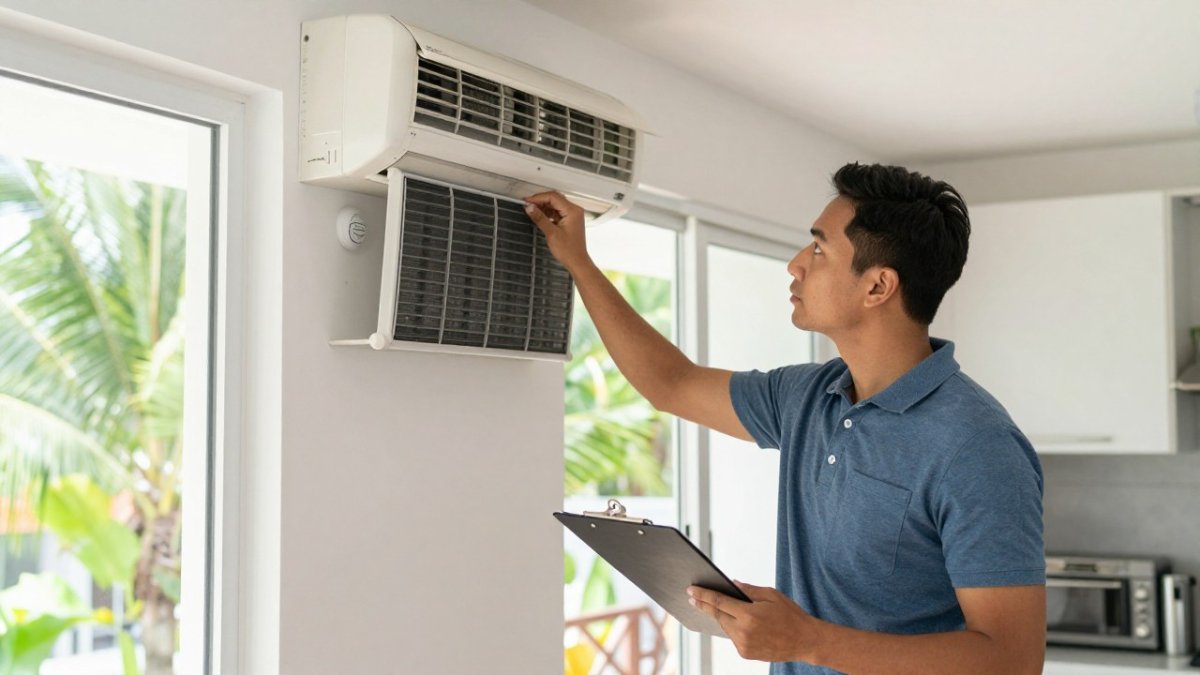
Before each guest cycle, confirm the following:
- Air conditioning runs and reaches a comfortable temperature
- Hot water arrives within a normal time at every tap
- No new drips, stains or soft spots appear under sinks or near windows
- Smoke and carbon monoxide alarms show a green light or pass a test
- Locks, keys and the door code work
- Outdoor lights, the pool and the hot tub are clean and safe to use
Smart home devices can help with this check. Remote temperature, leak and door sensors let you see problems from abroad. Choose devices that suit a luxury rental and can be managed from one dashboard.
Log each inspection with the date, the inspector and any issue found. The log proves the home was ready and shows patterns over time.
Off-Season Rental Maintenance: Preparing a Property for Low Occupancy
Low-occupancy periods give you room for larger jobs. Repainting, replacing worn furniture, servicing the roof and upgrading the internet are much easier when no one is staying.
Plan the off-season around three goals:
- Fix what guests would see: paint, flooring, linens and fixtures
- Protect what guests cannot see: plumbing, wiring, roof and drainage
- Prepare for the next high season: deep clean, restock and retest every system
Empty the property carefully. Shut off water where appropriate, unplug nonessential electronics and check that the security system and cameras still work. If the home will sit empty for weeks, set the air conditioning to a moderate temperature to limit humidity and mold.
Some owners leave the off-season unplanned and then rush the high-season reopening. Booking the work in advance avoids that pressure.
Assigning Task Ownership, Vendor Coordination and Budgeting
Most seasonal guides stop at the checklist. The part that actually protects revenue is the workflow behind it: who owns each task, when it is scheduled, how it is prioritized, and how the spend is tracked. This is the section competitors skip, and it is where remote owners lose the most money.
Task ownership and lead times
Every task needs one named owner, one backup, and a lead time measured backward from the season that makes it urgent. A workable pattern is:
- Owner or property manager: approves scope and budget, holds vendor relationships, reviews the log monthly.
- Housekeeping lead: owns the pre-guest inspection and reports defects within 24 hours of checkout.
- Trade vendors: hold standing appointments for HVAC, plumbing, electrical and pool service, booked before the high season rather than during it.
- Trusted local contact: holds keys or access codes and can meet a vendor on short notice.
Set lead times backward from the season. Roof and drainage work should be booked at least six to eight weeks before the rainy season, because reputable trades fill their calendars first. Pool and HVAC service should be booked before the dry-season peak, not during it. A task with no owner and no lead time is a wish, not a plan.
Prioritization framework
Rank every task on four axes before spending a colón:
- Safety: alarms, gas, electrical, pool barriers and structural issues come first, always.
- Urgency: water intrusion and active leaks escalate within days, not weeks.
- Guest impact: air conditioning, hot water, internet and cleanliness affect reviews directly.
- Cost of delay: a small repair that becomes a large one moves up the list.
A simple rule: safety and active water issues are fixed immediately from the reserve; guest-impact items are scheduled into the next low-occupancy window; cosmetic and upgrade work waits for the off-season.
Budgeting and the seasonal reserve
Split the maintenance budget into two lines. The routine line covers planned work: filter changes, pool chemicals, pest control, alarm batteries, gutter clearing. The reserve covers surprises: a failed water heater, a roof leak, an emergency call-out during a stay.
Track spend per property and per booking, not just in total. A property whose maintenance spend per booking is rising is telling you something the total hides.
Tracking and performance metrics
A log turns a checklist into a management system. Record, for each property:
- Date, inspector and result of every inspection
- Work orders opened and closed, with response time and completion time
- Repeat failures on the same system
- Maintenance spend per booking and per property
- Guest-reported issues and how quickly they were resolved
Review the log monthly and the metrics quarterly. A falling count of issues per inspection suggests prevention is working. A rising count of repeat failures on one system suggests the fix, not the symptom, needs attention.
Watch out: letting a single vendor handle every trade can hide problems and inflate costs. Get a second opinion on any large repair before you approve it, and keep at least two contacts per trade so you are never held to one calendar.
Guest communication during occupied stays
Maintenance does not pause because a guest is in residence. Agree in advance how access works: notice periods, who contacts the guest, and which issues justify entering the property. Keep an emergency contact reachable during stays, and route non-urgent work to the gap between bookings. A guest who is told in advance about a scheduled service is far more forgiving than one surprised by a technician at the door.
Booking Your Seasonal Maintenance Plan With Marquis Stays
Putting all of this into practice takes time, and most remote owners would rather spend that time on other things. Marquis Stays Property Management provides full-service management for luxury coastal homes, including guest communication and maintenance.
To see how Marquis Stays could support your property, you can contact the team through the website. Pricing depends on the size of the home, its location and the services you choose. Visit the Marquis Stays Property Management website for current pricing or to request a quote.
Frequently Asked Questions
What maintenance should a vacation rental have each season?
Each season should cover the systems guests notice first: air conditioning and filters, water heater and plumbing, pool or outdoor equipment, roof, gutters and downspouts, and window seals. In a tropical coastal property, humidity drives most of the work, so plan mildew checks, pest control and deep cleaning of kitchen hood filters and dryer vents. Record each task with the date and the technician's name so the history stays useful when the next season starts.
How do you create a vacation rental maintenance schedule?
Start with the calendar of your booking peaks and dead weeks, then assign each recurring task to a month. Put inspections and system servicing into the low-occupancy windows, and schedule anything that requires guest-free days, such as deep cleaning or exterior painting, between stays. Assign an owner to every task, whether your property manager, a contracted technician or a housekeeping team, and review the schedule once a year against actual repair logs.
How often should a vacation rental be inspected?
A full property inspection is best done at least twice a year, once before the high season and once during the off-season, with a lighter walkthrough after each guest cycle. Safety items such as smoke detectors, carbon monoxide alarms and fire extinguishers should be tested monthly. Document every inspection with photos so you can compare condition over time and spot slow damage such as water staining or loose caulking early.
How should you prepare a vacation rental for the off-season?
Before the low-occupancy months, complete any deferred repairs, service the air conditioning and water heater, clean gutters and check the roof, and remove or protect outdoor furniture from wind and sun. Lock down the property with a documented shut-down routine: close water valves where appropriate, set safe temperatures, and confirm that pool or hot tub chemistry is stable. Keep a log so reopening the property in peak season takes hours rather than days.