Last Updated: November 12, 2026
Quick Summary
The essential beach safety tips for parents in Costa Rica start with watching the water for two full minutes before anyone enters, checking flags and CNE coastal advisories, and setting rules like never swimming alone and staying within arm's reach. Teach kids to float, breathe, and swim parallel to shore if caught in a rip current, and pack water, shade, and sunscreen for every trip.
- A red flag means no swimming, full stop.
- A flat, darker channel between breaking waves often marks a rip current.
- If you must enter the water for a child, take a board or floating object.
- Swim before 10 a.m. or after 3 p.m. to limit midday sun exposure.
- Offer kids drinking water every hour rather than waiting for thirst.
Table of Contents
- Why Beach Safety Demands a Parent's Full Attention
- Reading Ocean Conditions Before the Kids Reach the Water
- Rip Current Safety for Kids: Spotting the Danger and Setting Rules
- What to Do in a Rip Current: A Step-by-Step Response Plan
- Sun Protection for Kids at the Beach: Shade, Timing, and Gear
- The Beach Safety Checklist for Parents: What to Pack and Plan
- Non-Swimming Hazards: Wildlife, Heat, and Personal Belongings
- Book a Managed Beach Home That Puts Safety First
- Frequently Asked Questions
Why Beach Safety Demands a Parent's Full Attention
The ocean does not announce its hazards.
Children are the least equipped to read those signals. A child sees a beautiful blue stretch of ocean and runs toward it. A parent sees rip currents, drop-offs, and heat.
This guide gives you a parent-ready plan: how to read conditions, set supervision rules, respond to a rip current, and pack the right gear.
Reading Ocean Conditions Before the Kids Reach the Water
Stop at the sand and watch for two full minutes before anyone touches the water. That pause tells you more than any sign.
Look for these signals:
- Calm gaps between breaking waves. A flat, darker channel between white water often marks a rip current.
- Murky or churned water. Sudden color changes can mean a drop-off or strong outflow.
- Waves breaking close to shore. Powerful shorebreak slams kids down fast.
Check the flags and posted warnings first. A red flag means no swimming, full stop. Ask a local or your host about the specific beach.
Costa Rica's national emergency commission, the CNE, publishes coastal advisories, and it is worth checking Costa Rica's National Emergency Commission coastal advisories before you drive out.
Rip Current Safety for Kids: Spotting the Danger and Setting Rules
A rip current is a narrow, fast-moving channel of water flowing away from shore. It pulls swimmers out, not under. That distinction matters for how you teach your kids to react.
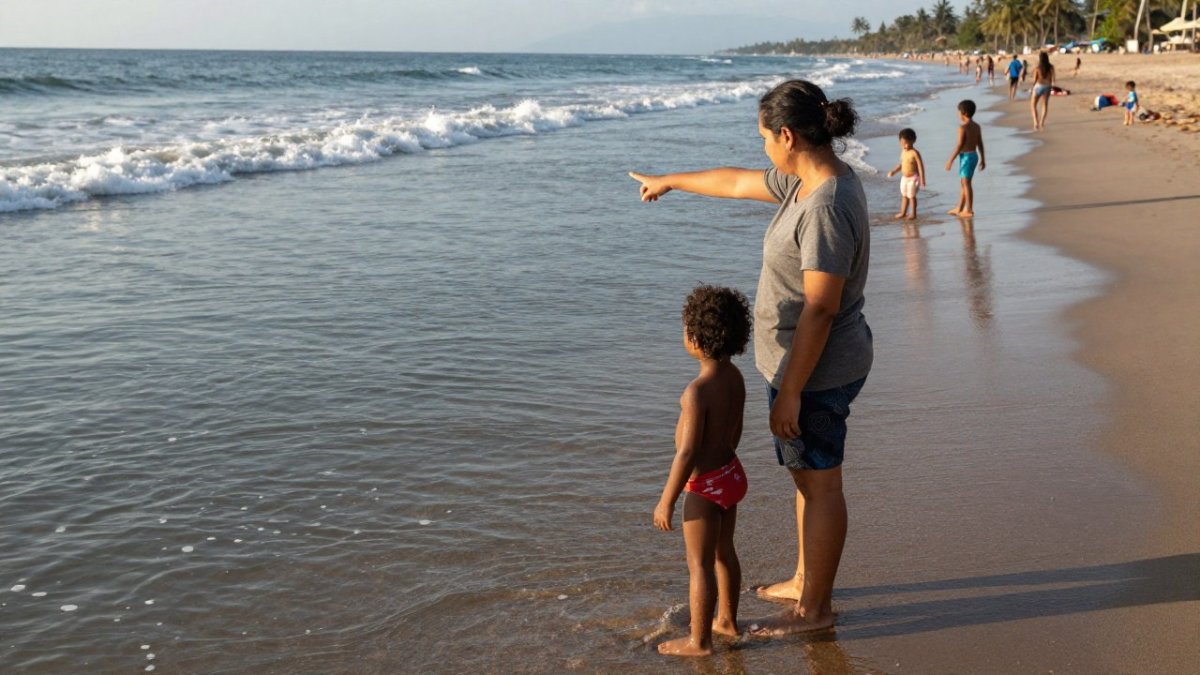
Set these rules before the first swim:
- Never swim alone. Kids stay within arm's reach of an adult.
- Swim near other people. Crowded water is safer water.
- Point out the calm channel. Show your child where not to go.
- Pick a landmark. Agree on a fixed spot on the sand to return to.
Rip current safety for kids comes down to one idea: your child should know what to do before it happens. Rehearse it on dry sand.
What to Do in a Rip Current: A Step-by-Step Response Plan
Teach your child this sequence and repeat it until it is automatic. Calm water practice on the sand builds the memory.
- Do not fight it. Fighting the current tires a swimmer out fast.
- Float and breathe. Stay calm and keep your head above water.
- Swim parallel to shore. Move sideways until the pull stops.
- Then swim back at an angle. Head diagonally toward the beach.
- Call for help. Wave and shout if you cannot make progress.
If you are the parent on shore, do not swim straight into the current after them. Call for a lifeguard, point, and keep your child in sight. Many beaches have no lifeguard, so your plan must assume you are the first responder.
The Parent's On-Shore Response Plan
When a child is caught in a rip current, the adult on shore has four jobs, in this order:
- Keep your eyes on the child. Point with your whole arm so other adults can see where to look. Do not turn your back to search for a phone.
- Send someone else for help. If another adult is present, direct them to call 911 and find a lifeguard or a local who knows the water. Do not leave the child unattended to make the call yourself.
- Talk the child through the sequence. Shout calm, short instructions: "Float. Breathe. Swim sideways." A child who hears a familiar voice is less likely to panic and fight the current.
- Go only with flotation. If you must enter the water, take a board, a cooler, or any floating object. A tired parent without flotation becomes a second victim.
Watch out: do not send another child to help. A sibling or friend who swims toward a panicking swimmer is likely to be pulled into the same current.
Rehearse by Age and Ability
The response plan only works if your child can execute it under stress. Adjust the rehearsal to the child:
- Toddlers and preschoolers. They cannot self-rescue. Stay within arm's reach, hold them in the shorebreak, and never let them past knee depth. Practice "hold my hand and stop when I stop" on the sand.
- Young children (roughly 5-9). Practice the float-and-breathe step in shallow water where they can stand. Teach them to shout "help" loudly and wave one arm, and to point to the agreed landmark on the sand.
- Confident swimmers (roughly 10 and up). Run the full sequence in calm water: float, swim parallel, angle back. Quiz them before every swim: "What do you do if the water pulls you out?" A child who can answer in one sentence is ready.
Flotation aids are not a substitute for supervision. Armbands, noodles, and boogie boards help a child float, but they do not teach a child to read a current or stay calm. Treat them as a backup, never as a babysitter.
Share the Beach Location Before You Need It
Emergency responders need a precise location, and "the beach near our rental" is not enough. Before anyone enters the water, agree on a location description you can give in one sentence:
- The name of the beach or the nearest access point.
- The nearest landmark visible from the sand, such as a hotel, a river mouth, or a lifeguard tower.
- The color and number of the nearest posted sign or flag.
Save the local emergency number in your phone before you leave the rental. If the beach has a lifeguard, note the tower's location and hours; many beaches here have no lifeguard at all, so your plan must assume you are the first responder until help arrives.
For a wider family trip plan that folds in sun, timing, and packing, see our guide on how to plan a sustainable Costa Rica trip.
Sun Protection for Kids at the Beach: Shade, Timing, and Gear
Sunburn ruins more family beach days than any current. Midday exposure on open sand can be intense.
Plan around these habits:
- Swim early or late. Aim for before 10 a.m. or after 3 p.m.
- Build shade. Bring a beach tent or umbrella and use it.
- Cover up. Rash guards and wide-brim hats beat sunscreen alone.
Hydration belongs in the same conversation. Kids dehydrate before they notice thirst. Pack more drinking water than you think you need and offer it every hour.
For a wider family trip plan that folds in sun, timing, and packing, see our guide on how to plan a sustainable Costa Rica trip.
The Beach Safety Checklist for Parents: What to Pack and Plan
A beach safety checklist for parents should cover gear, rules, and a plan for the day. Pack once, check it every trip.
- Drinking water for each person, plus a spare bottle
- Sunscreen, rash guards, and hats
- Beach tent or umbrella for shade
Before you leave the house, set the day's rules out loud. Who supervises whom. Where the family meets if separated. Which adult holds the phone.
| Hazard | Warning Sign | Parent Action |
|---|---|---|
| Rip current | Calm channel between waves | Swim parallel, float, call for help |
| Shorebreak | Waves crashing close to shore | Keep kids in shallow water |
| Heat and sun | Strong midday glare | Shade, water, early swim |
| Wildlife | Posted signs, murky water | Ask locals, stay clear |
Non-Swimming Hazards: Wildlife, Heat, and Personal Belongings
The water is only half the risk. Some of the most common family incidents here happen on dry sand, and they are the ones parents are least prepared for because they do not look like emergencies until they are.
Heat Illness and Dehydration
Heat is the quiet hazard. A child can overheat on open sand within an hour, and the first signs are easy to miss because they look like ordinary crankiness. Watch for these in order:
- Early signs. Thirst, headache, crankiness, and flushed skin. A child who suddenly stops playing and lies down on the sand is telling you something.
- Worsening signs. Dizziness, nausea, stopped sweating, and confusion. Move the child to shade, loosen clothing, and offer cool water in small sips.
- Emergency signs. Fainting, vomiting, or a child who will not wake fully. Call 911 and cool the child with wet towels while you wait.
A common pattern is that families drink water at meals but not on the sand. Pack a bottle for each person plus a spare, and offer water every hour rather than waiting for thirst. A child who is already cranky from heat is harder to supervise near the water.
Shorebreak and Waves Knocking Children Down
Shorebreak is the wave that crashes close to shore and slams a child down in ankle-deep water. It is the most common cause of minor beach injuries for young children, and it happens fast. Keep toddlers and young children in water below the knee, hold their hand in the wash zone, and stand between the child and the incoming wave.
Wildlife and River Mouths
Ask locals before swimming near any river that meets the sea, and watch for posted signs. The same rule applies to any murky, slow-moving water at the back of the beach: if the water is not clearly open ocean, treat it as wildlife habitat until a local tells you otherwise.
Sharp Objects and Safe Play Near the Shoreline
Broken shells, glass, and fishing debris collect at the high-tide line. Walk the stretch where your children will play before you set down your towels, and pick up anything sharp. Keep kids away from rocks and tide pools where waves can surge unexpectedly, and set a clear boundary: the family plays between the towels and the knee-deep line unless an adult is in the water with them.
Personal Belongings
Personal belongings vanish on busy beaches. Leave valuables at your rental. Carry only cash in a waterproof pouch, and never leave bags unattended while everyone is in the water. Agree before you arrive who holds the valuables and where they stay.
The Supervision Plan for Dry Sand
The non-swimming hazards are where a designated water watcher is not enough, because the risk moves from the water to the sand. Assign one adult to watch the water and another to watch the sand when both are in use. If you have only one adult, keep the children together in one spot and rotate: water time, then shade time, then a walk, so no child is ever out of sight while you are distracted.
| Hazard | Warning Sign | Parent Action |
|---|---|---|
| Rip current | Calm channel between waves | Swim parallel, float, call for help |
| Shorebreak | Waves crashing close to shore | Keep kids in shallow water, stand between child and wave |
| Heat and sun | Strong midday glare, crankiness | Shade, water every hour, watch for confusion |
| Wildlife | Posted signs, murky water, river mouth | Ask locals, stay clear, never swim at dusk |
| Sharp objects | Debris at high-tide line | Walk the play area first, set a boundary |
Book a Managed Beach Home That Puts Safety First
The safest beach day starts with a base that understands the coast.
You can review the amenities and safety features of a managed rental before you book.
See what professional property management near Arenal looks like when a team handles the details.
Parents scouting calmer, family-friendly stretches of coastline can also browse our picks for the best hidden beaches for families.
The ocean rewards preparation and punishes assumption.
Frequently Asked Questions
How can parents keep children safe at the beach?
Set three non-negotiables: an adult stays within arm's reach of any child under five, older kids swim only in lifeguarded areas with a buddy, and everyone exits the water at the first red flag or thunder rumble. Assign one parent as the designated watcher and rotate every 20 minutes so attention stays sharp. Before unpacking, walk the shoreline together and point out the lifeguard tower, the safest swimming zone, and a meeting spot if anyone gets separated.
What should families know about rip currents?
Rip currents are narrow channels of water flowing away from shore, often between sandbars or near piers. They pull you out, not under, so the danger is panic and exhaustion. Teach kids to look for calm, darker gaps between breaking waves and to stay away. If caught, they should not fight the current. Floating and calling for help while waving one arm is the correct response, then swimming parallel to shore once the pull weakens.
How closely should parents supervise children in the ocean?
For children under five, an adult should be in the water within arm's reach at all times. Ages six to twelve need active watching from the shore, meaning eyes on the child every few seconds, not reading or scrolling. Teens still need a buddy and a visible check-in point. Drowning is silent, so a child who slips below the surface may not splash or call out. Rotate supervision duties and avoid alcohol entirely while watching kids.
What should families pack for a safe beach day?
Pack reef-safe sunscreen, a shade umbrella or pop-up tent, refillable water bottles, a first-aid kit, and a waterproof pouch for phones and cash. Bring a bright towel or shirt so each child is easy to spot, and a small cooler for snacks to keep energy up in the heat. A beach safety checklist for parents should also include a charged phone, a printed list of local emergency numbers, and a hat and rash guard for every child.