Quick Summary
Outdoor lighting for a Costa Rica vacation home should cover the pathways, steps, and entrances guests use most, with warm, low-output LEDs aimed downward. Use IP65 or higher fixtures in solid brass or marine-grade aluminum, and sensors or timers so the system works without an owner on site.
- Light the walkways, steps, and entrances guests use most, since dark paths signal risk.
- Choose warm-white LEDs at low output and aim fixtures down toward the path.
- Specify at least IP65 for exposed walls and posts, and IP67 for ground-level fixtures.
- Use solid brass or marine-grade aluminum fixtures to resist salt-air corrosion.
- Inspect connections and wipe lenses monthly, with a qualified electrician reviewing circuits annually.
Table of Contents
- Why Outdoor Lighting Decides Guest Safety and Booking Appeal
- Outdoor Pathway Lighting That Guides Guests Safely at Night
- Patio Lighting Ideas for Vacation Homes That Guests Notice
- Outdoor Lighting for Tropical Climates: Humidity, Rain and Salt Air
- Wildlife-Friendly Lighting and Limiting Light Pollution
- Outdoor Lighting Maintenance Checklist for Remote Owners
- Booking Your Outdoor Lighting Plan and Next Steps
- Frequently Asked Questions
Why Outdoor Lighting Decides Guest Safety and Booking Appeal
Outdoor lighting is the first thing a guest experiences after dark, and it shapes how safe the property feels long before anyone walks inside. For remote owners of Costa Rica vacation homes, a well-planned exterior lighting setup protects guests, reduces liability, and supports stronger booking decisions.
Guests read a property's lighting quickly. Dark driveways, unlit entrances, and shadowy garden paths signal risk, even when the home itself is secure. Bright, even, and thoughtfully placed light does the opposite. It shows guests where to step, where to park, and where the door is.
Lighting also influences how a listing performs, since photos taken at dusk and evening guest reviews often mention how a property felt at night.
Keep these priorities in mind as you read through the sections below:
- Safety first: Light the paths, steps, and entrances guests use most.
- Guest comfort: Warm, layered light makes outdoor areas usable after sunset.
- Durability: Fixtures must survive humidity, rain, and salt air.
- Responsible design: Good lighting avoids glare and light pollution that disturbs wildlife and neighbors.
Outdoor Pathway Lighting That Guides Guests Safely at Night
Pathway lighting is the most important outdoor lighting decision for most vacation homes. Guests arriving after dark need to find the entrance without stumbling over roots, stones, or uneven ground. Low-level path lights spaced every few metres along walkways solve this problem with minimal glare.
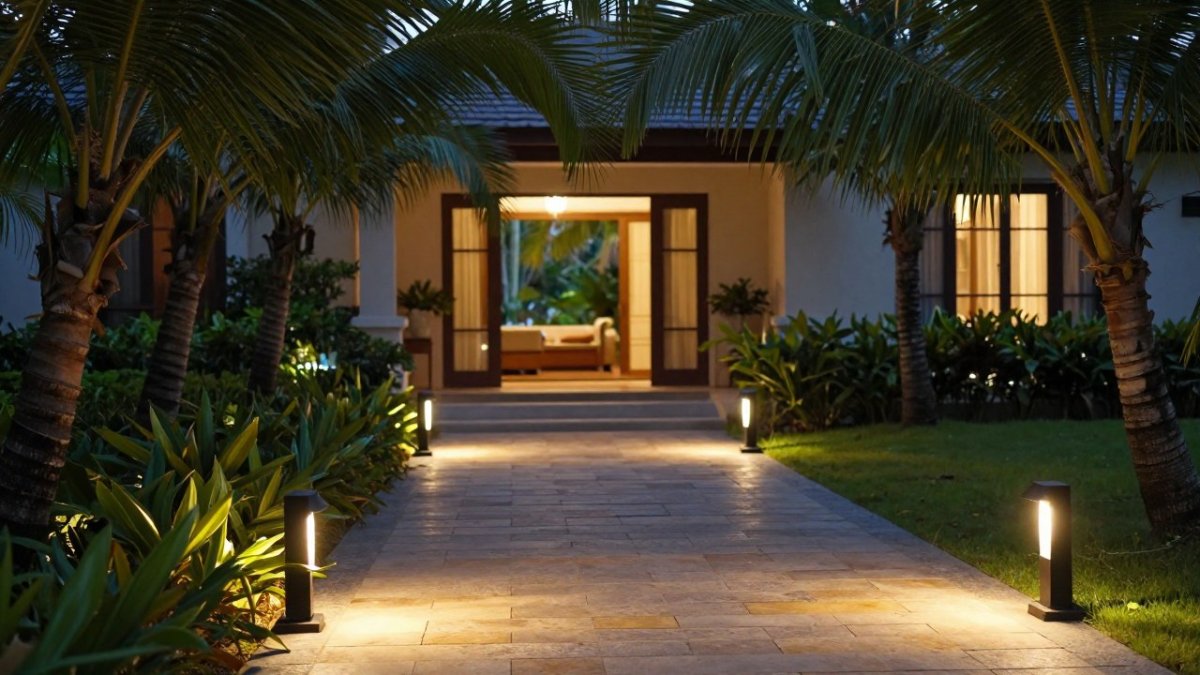
Place fixtures where the ground changes, such as at steps, turns, and junctions with garden beds. Motion-sensor lights at the gate and parking area help guests and staff find their way without leaving lights on all night.
Watch out: Overly bright pathway lights can blind guests and create harsh shadows. Choose warm-white LEDs at low output and aim fixtures down toward the path.
Patio Lighting Ideas for Vacation Homes That Guests Notice
Patios, terraces, and covered outdoor dining areas are where guests spend their evenings, and they are also where poor lighting causes the most complaints. Layered lighting makes these spaces feel inviting, but a remote owner needs a plan that works without daily supervision. The most useful approach is to treat the patio as a set of zones, each with its own fixture type, control, and safety purpose.
Zone 1: The dining and seating area. This is the social core. Use a dimmable pendant or a pair of wall sconces at roughly 2.4 to 3 metres above the table so light falls onto the surface rather than into guests' eyes.
Zone 2: The transition from indoors to outdoors. The threshold between the living room and the terrace is where guests trip, drop keys, and fumble with locks. A shielded wall light on each side of the door, plus a low step light at any level change, removes the shadow pocket that forms when interior light spills outward. Keep this circuit on a motion sensor or a timer so it is on whenever guests arrive or move between rooms after dark.
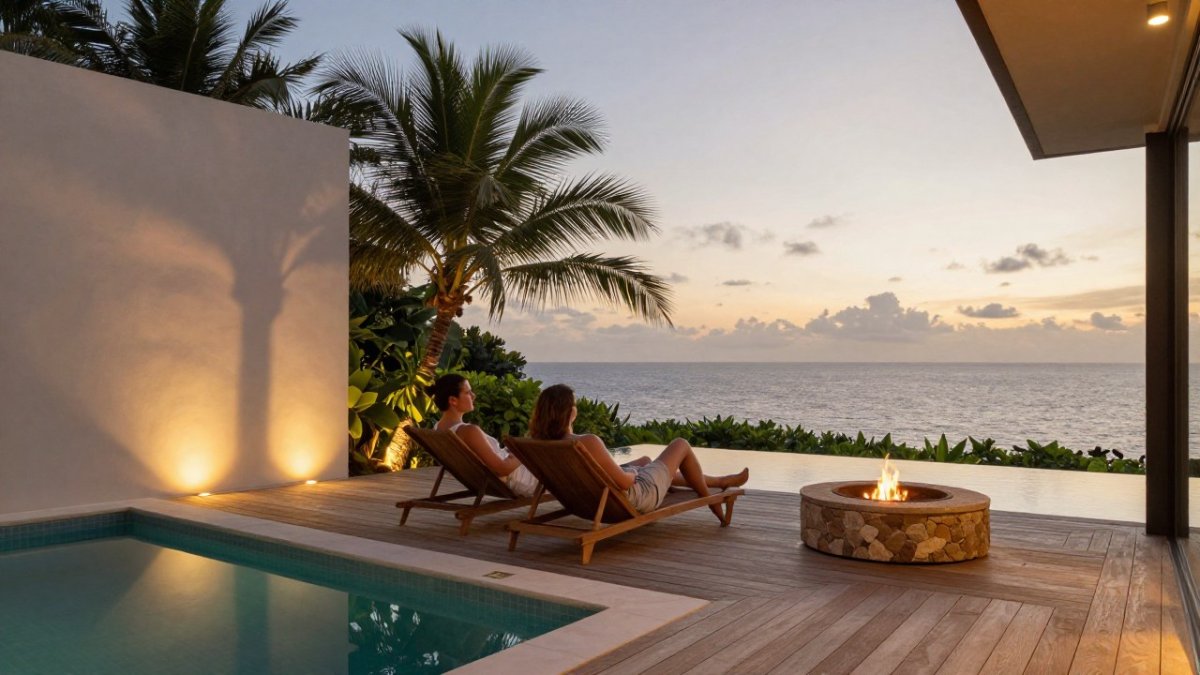
Zone 3: The pool deck and wet areas. Pool surrounds need even, glare-free illumination so guests can see the edge and the water line. Use low-voltage deck lights or flush-mounted fixtures rated for wet locations, and place them so the pool edge is visible from the house. Avoid uplights that reflect off the water surface into guests' eyes.
Zone 4: Planting beds and accent features. Accent light adds depth and makes the patio feel designed rather than utilitarian. Uplighting a palm trunk or a specimen plant, or a small lantern near a bed, is enough. Keep accent fixtures on a separate circuit so they can be turned off when guests want a darker, quieter evening.
Controls that make the plan work without an owner on site. A simple arrangement is a timer or astronomical clock for the path and entrance circuits, motion sensors for the gate and parking area, and dimmers for the patio. Label every switch clearly inside the house; guests should not have to guess which breaker controls the terrace.
Watch out: Overly bright patio lighting creates glare, harsh shadows, and light spill into neighbouring properties and wildlife habitat. Choose warm-white LEDs at low output, shield every fixture, and aim light down toward the surface rather than outward.
A patio lighting plan that separates dining, transition, pool, and accent zones gives guests control, keeps the safe route lit, and reduces the maintenance surprises that come from a single overloaded circuit.
Outdoor Lighting for Tropical Climates: Humidity, Rain and Salt Air
The coastal climate is hard on electrical equipment. High humidity, heavy seasonal rain, and salt air corrode unprotected metal, degrade seals, and shorten the life of cheap fixtures. Choosing equipment built for these conditions is an important step a remote owner can take. The guidance below focuses on the specification, installation, and operating decisions that actually determine whether a system survives.
Start with the IP rating, then the material. The IP (Ingress Protection) rating tells you how well a fixture keeps out dust and water (bsigroup.com). For exposed walls, posts, and path lights, choose at least IP65. For ground-level fixtures that may be splashed or sit in standing water after a storm, choose IP67.
| Lighting type | Typical location | Weather resistance | Durability in salt air | Best for |
|---|---|---|---|---|
| Solid brass or marine-grade aluminum fixtures | Entrances, patios | High | High | Coastal properties within sight of the ocean |
| Powder-coated steel with sealed housings | Walls, gates | Medium-high | Medium | General exterior use |
| Low-voltage LED pathway lights | Walkways, gardens | High | Medium-high | Paths and planting beds |
| Standard indoor-rated fixtures used outdoors | Covered areas only | Low | Low | Sheltered spots, short-term use |
Sealed housings and cable connections are where systems fail. A fixture can carry a high IP rating and still fail if the installer leaves a gland loose or a junction box exposed. Ask for sealed housings, gasketed lenses, and waterproof connectors on every exterior circuit. Bury cable in conduit where it crosses garden beds, and keep junction boxes above ground level and under cover.
Low-voltage LED is usually the right base system. Low-voltage LED path and garden lights are safe to touch, energy efficient, and easy to expand zone by zone.
Plan for maintenance, not just purchase. Salt film, mildew, and insect nests accumulate on lenses and housings, and they reduce output long before a fixture fails. A quarterly wipe-down and an annual inspection of seals and connections will extend the life of the system considerably. Brass requires periodic polishing in salt air; marine-grade aluminum needs less attention but should still be checked for pitting.
Operating cost and solar options. LED fixtures draw very little power, so the ongoing electricity cost of a low-voltage system is generally modest. Maintenance and replacement labour are the larger ongoing costs, which is one reason corrosion-resistant equipment is worth considering from the start.
Watch out: A fixture rated for outdoor use but installed with an unsealed connection or a loose gland will fail in the first heavy rain, and the resulting dark path is a guest-safety problem rather than a maintenance inconvenience. Have a qualified electrician review every exterior connection before the rainy season.
Specifying for humidity, rain, and salt air is not about buying the most expensive fixture. It is about matching the IP rating and material to the exposure, sealing the connections, sizing the transformer with headroom, and building a maintenance routine that a remote owner can actually follow.
Wildlife-Friendly Lighting and Limiting Light Pollution
Many vacation homes sit close to forest edges, nesting beaches, and riverbanks. Bright, unshielded lighting can disrupt nesting wildlife and spill into neighbouring properties.
Use these principles to keep lighting responsible:
- Choose warm-white or amber LEDs for outdoor use.
- Use fully shielded fixtures that direct light downward.
- Install motion sensors so lights stay off when no one is present.
- Keep lighting on beachfront properties low and avoid lights that face the shoreline during turtle nesting season.
Responsible lighting does not reduce guest safety. It concentrates light where people need it and avoids wasting it on the sky, the trees, and the neighbors.
Outdoor Lighting Maintenance Checklist for Remote Owners
Remote owners cannot inspect fixtures every week, so a simple recurring checklist keeps the system working and the property looking its best. The checklist below works for any owner or manager.
Monthly checks:
- Walk the pathways after dark and note any dark spots or failed fixtures.
- Confirm motion sensors trigger at the gate, entrance, and parking area.
- Wipe down fixture lenses and housings to remove salt film and mildew.
- Check that dimmers and timers respond correctly.
Quarterly checks:
- Inspect cable connections and junction boxes for moisture or corrosion.
- Trim plants that block light or cast harsh shadows on paths.
- Test outage-ready lighting, such as battery backup units, if installed.
Annual checks:
- Have a qualified electrician review the full circuit, transformer load, and grounding.
- Replace any fixture with a cracked lens, failed seal, or heavy corrosion.
- Update the lighting plan if the property layout or guest use has changed.
Keep a written record of every repair and replacement. This record helps when you review costs or switch management providers.
Booking Your Outdoor Lighting Plan and Next Steps
A strong outdoor lighting plan improves guest safety, supports bookings, and protects your property investment. The right plan depends on your property's layout, exposure to the coast, and the way guests use the grounds. Costs for fixtures, installation, and ongoing maintenance depend on the size of the property and the materials chosen, so request a quote from Marquis Stays Property Management for current pricing.
If you own a luxury home in Guanacaste and want a lighting review as part of professional management, contact Marquis Stays Property Management to discuss your property.
Frequently Asked Questions
What outdoor lighting should a vacation rental have?
At minimum, a vacation rental needs lighting at every entrance, along the main walking routes between parking, the house and any pool or garden area, and on the patio or terrace where guests gather after dark. Motion-sensor fixtures at doors and driveways add security without leaving lights burning all night. Choose fixtures rated for outdoor and humid use, typically IP65 or higher, and use warm colour temperatures around 2700K to 3000K so the property feels welcoming rather than harsh. Keep a short list of fixture locations so the property manager can check each one during regular inspections.
How do you light outdoor paths safely at night?
Use low-height bollard or step lights spaced so each walking surface receives overlapping light, avoiding bright spots that cause glare and leave dark gaps. Place fixtures to light the path surface rather than shining into guests' eyes, and mark steps, level changes and uneven stone clearly. Shielded fixtures keep light on the ground and reduce spill toward neighbouring properties. Test the route at night before each high season, walking it as a guest carrying luggage would, and adjust any spot that feels dark or blinding.
Are solar lights a good choice for vacation homes?
Solar fixtures work well for decorative garden accents and secondary pathway marking where wiring is difficult, but they are less reliable as primary safety lighting. Tropical rainy seasons bring extended cloud cover, which reduces charging, and batteries degrade faster in heat and humidity. Choose units with replaceable batteries, sealed housings and a rating of at least IP65, and plan to replace batteries roughly every one to two years. For entrances, stairs and parking areas, hard-wired LED fixtures give more dependable performance.
How do you protect outdoor lights from humidity and rain?
Specify fixtures with IP65 or higher ingress protection, marine-grade or powder-coated aluminium or stainless steel housings, and UV-stable lenses. Salt air near the coast corrodes cheap metals quickly, so inspect fittings and wiring connections regularly and use dielectric grease on exposed contacts. Mount fixtures where water does not pool, add drip loops to cables, and use outdoor-rated junction boxes. Wipe lenses and check seals during each maintenance visit to catch condensation or insect ingress early.